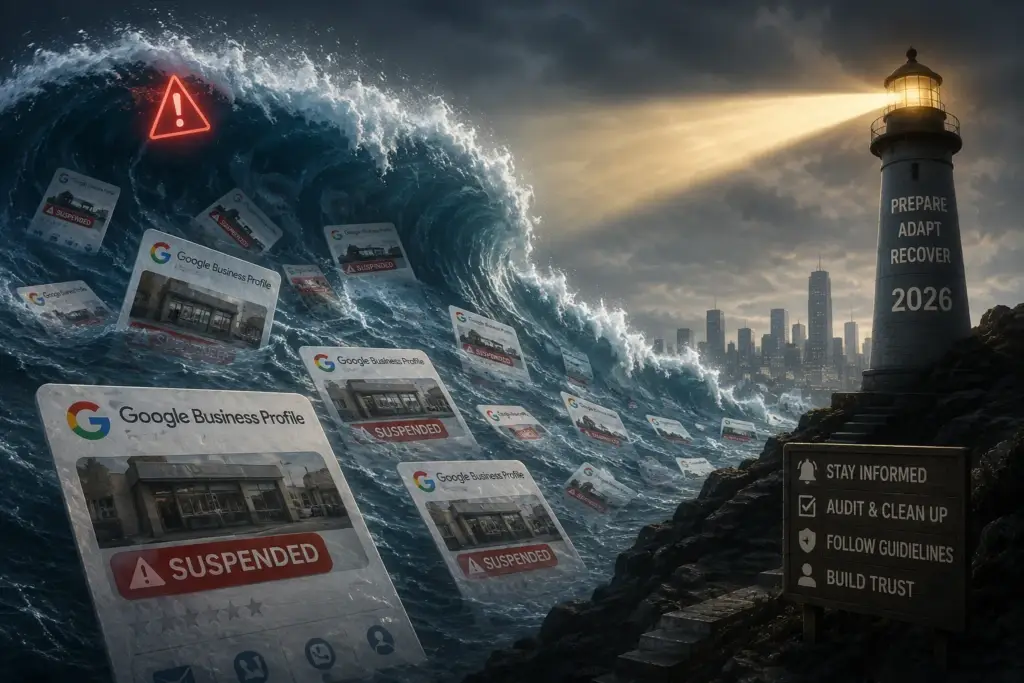
In late April and early May 2026, Google executed two back-to-back enforcement sweeps that left thousands of business owners staring at a GBP suspended notice with no individual warning and no clear explanation. Home services businesses in California were hit hardest, but the impact spread across industries and geographies within days.
This was not a glitch. It was a deliberate, Gemini-powered enforcement campaign — and it is not going away.
If your Google Business Profile was caught in either wave, or you manage profiles for clients who were affected, this is what actually happened, what caused it, and what the recovery path looks like from someone who has handled over 250 GBP reinstatements with a 98% success rate.
Wave 1: April 27, 2026 — Thousands of Profiles GBP Suspended Overnight
On the morning of April 27, 2026, business owners across California woke up to suspension notifications on their Google Business Profiles. Every single one carried the same stated reason: “Deceptive Content.”
No specific trigger was identified. No individual warning was issued. This was a mass algorithmic sweep targeting entire categories and geographies simultaneously.
According to certified Google Product Experts tracking the incident, this was a geographic and category-level enforcement action — not account-level. Profiles that had been verified through Google’s own video verification process were suspended. Profiles with years of reviews and accurate information were suspended. If your profile was GBP suspended in this wave, you were far from alone.
The industries hit hardest were garage door repair, locksmith services, landscaping, and general contracting — all categories where spam listings have historically been prevalent. Google’s AI applies a significantly lower risk threshold in these verticals before flagging a profile.
Here is what “Deceptive Content” actually means in this context: it does not mean your business is fraudulent. It means Google’s automated systems assigned a risk score above the current enforcement threshold. Legitimate businesses get caught in these sweeps every time Google tightens its model.
Wave 2: May 3–4, 2026 — Entire Accounts GBP Suspended Through Restrictions
Less than one week later, a second and far more severe action began.
This time, Google was not suspending individual profiles. It was restricting entire Google Accounts. The notification read: “Your profile has been put under restriction due to policy violation. Business Profiles you manage will be suspended and you won’t be able to create or claim other profiles.“
The practical implication for agencies and multi-location businesses: Every profile under that account is effectively GBP suspended at once.
The routing ID appearing on these restrictions — DPNB — is a code that Google Product Expert communities have consistently flagged as the most difficult tier to resolve. DPNB cases have a substantially lower success rate through standard appeal channels. The appeal button is often broken. Responses are delayed or nonexistent. Standard appeals frequently stall entirely.
The most consistent pattern across restricted accounts is a connection to Local Services Ads (LSA) or Google Ads activity. In Google’s current integrated enforcement architecture, a policy flag in any one system — Ads, LSA, or GBP — can cascade automatically to the others.
Was your profile or account hit by Wave 1 or Wave 2? Get a free case evaluation
What Is Actually Driving This
Neither wave happened in isolation. Google has been building toward this enforcement posture throughout 2025 and into 2026, and the data tells the story clearly.
The 2025 Trust & Safety Report Numbers
Google’s 2025 Maps Content Trust & Safety Report, published April 16, 2026, revealed the scale of enforcement:
- 292 million policy-violating reviews blocked or removed — roughly 22% of all reviews submitted globally that year
- 79 million inaccurate or unverified edits to Business Profiles blocked
- 13 million fake Business Profile listings removed
- Posting restrictions placed on more than 782,000 policy-violating accounts
These are not small numbers. Any business can find itself GBP suspended when enforcement operates at this volume.
The April Policy Changes
On April 16, 2026 — just eleven days before Wave 1 — Google activated Gemini-powered edit moderation, an AI system that reviews profile changes in real time before they are published and flags suspicious content proactively. On April 17, Google expanded its Rating Manipulation policy with new explicit prohibitions.
These two moves were the runway for what happened on April 27. The Gemini enforcement infrastructure was in place. The policy framework had been updated. Then the sweep began.
The Bigger Picture
Google is cleaning its local search ecosystem ahead of a future where AI Overviews and Gemini-powered summaries dominate local results. The algorithm is being retrained on quality signals, and businesses that were tolerated under the old threshold may not survive the new one.
This is not temporary. This is a permanent shift in how Google moderates local visibility.
What This Means for Your Business
Whether your profile was GBP suspended in Wave 1 or restricted in Wave 2, the underlying enforcement logic is the same. Three practical implications most business owners and agencies have not yet acted on:
1. Separate Managed Accounts — This Is No Longer Optional
Managing multiple clients’ profiles or multiple business locations from a single Google Account is a structural liability under Wave 2’s account-level enforcement model. A restriction on one account takes down every client or location simultaneously. Separate accounts per client or location is no longer a best practice — it is risk management.
2. Verification History Does Not Grant Immunity
Video verification, long-standing reviews, accurate information — none of these prevent a profile from being GBP suspended in an algorithmic sweep. The only protective factor is keeping your profile out of the risk-scoring criteria that trigger algorithmic flags: no keyword stuffing in the business name, accurate category selection, no engagement pattern anomalies, no review manipulation signals.
3. The LSA–GBP Integration Is a Live Threat
If you run Local Services Ads, a policy issue in your Ads account can now trigger a GBP restriction. This cross-system enforcement is new. Reviewing active LSA and Google Ads configurations for policy compliance is no longer just an ads hygiene task — it is GBP protection.
Building Suspension Resilience
The April–May 2026 waves exposed a structural vulnerability in local SEO strategy: Google Maps cannot be your only lead source.
For any business dependent on local search, being GBP suspended produces immediate consequences — disappearance from Google Maps, local pack rankings that drop to zero, Local Services Ads impacted by location extension loss, and reviews invisible to potential customers during the appeal window. If 60–80% of your inbound calls come from Google Maps, a GBP suspended status is a revenue emergency.
Building suspension resilience means operating as if the profile could disappear tomorrow:
Authoritative directory citations (BBB, Yelp, Angi, Houzz) serve dual purpose — they corroborate business legitimacy in appeal documentation and provide alternative search visibility.
A well-optimized website with service area content and schema markup is the only local search asset you fully control.
Documented business evidence — license, insurance, registration, utility bills — should be organized and current at all times, not assembled in a panic after a suspension notice.
The businesses that will fare best through Google’s 2026 enforcement acceleration are the ones treating GBP as one channel in a diversified local strategy, not the strategy itself.
Recovery: What Actually Works
For Wave 1 “Deceptive Content” Suspensions
If your profile was GBP suspended with a ‘Deceptive Content’ label, do not appeal immediately. Audit the profile first. Ensure the business name matches the legal registration exactly, the address is verifiable, and no descriptions contain keyword additions or misleading claims.
Gather documentation before opening the appeal form. Google gives approximately 60 minutes once the upload window is open. Have everything ready: business license, state registration, insurance certificate, photos of vehicle or equipment, utility bill with business name and address.
Submit once, with a factual, concise explanation. Multiple identical appeal submissions can result in Google permanently blocking future appeals.
Expect 3 to 14 business days for straightforward cases.
For Wave 2 Account-Level Restrictions (DPNB)
Standard appeals have a significantly lower success rate on DPNB cases. Escalation through a certified Google Product Expert — someone with direct access to internal channels that bypass the standard queue — is the practical path.
Complex DPNB cases extend to 3 to 6 weeks minimum without Product Expert escalation.
The One Thing to Avoid at All Costs
Creating a new Business Profile for the same business at the same address while your profile is GBP suspended produces an automatic hard suspension of the new profile and further complicates the existing appeal. Do not do this under any circumstances.
If you are dealing with a soft suspension versus a hard suspension or disabled listing, the recovery approach differs significantly. Understanding why Google suspended your profile in the first place is the starting point for any successful reinstatement.
→ Get expert help if your profile was GBP suspended. Contact us for a free case review.
Frequently Asked Questions
Why did Google mass-suspend Business Profiles in April 2026?
Google executed a geographic and category-level enforcement sweep on April 27, 2026, targeting industries with historically high spam rates — particularly home services in California. The suspensions were powered by Gemini AI enforcement tools activated on April 16, 2026, and were part of Google’s broader campaign to clean its local search ecosystem. Legitimate businesses were caught alongside spam listings because Google’s automated risk scoring applies category-wide thresholds, not individual assessments. Thousands of legitimate businesses found themselves GBP suspended overnight.
What is a DPNB routing ID on a Google Business Profile restriction?
DPNB is a routing identifier that appears on account-level restrictions issued during Google’s May 2026 Wave 2 enforcement action. DPNB cases are the most difficult tier to resolve through standard Google appeal channels. The appeal button is frequently broken, responses are delayed, and standard appeals often stall. Resolution typically requires escalation through a certified Google Product Expert with access to internal channels.
Can a Google Ads or LSA issue cause a GBP suspension?
Yes. Google’s current integrated enforcement architecture means a policy flag in Google Ads or Local Services Ads can cascade to your Google Business Profile. A restriction in one system can trigger review and enforcement across all connected Google products. This cross-system enforcement became visible during the May 2026 Wave 2 account restrictions.
How do I protect my Google Business Profile from future suspension waves?
Ensure your business name matches your legal registration exactly, your address is verifiable, your categories are accurate, and your profile contains no keyword stuffing or misleading claims. Manage each client or location from a separate Google Account. Keep business documentation current and organized. Diversify your local visibility beyond Google Maps. Review any active Google Ads or LSA campaigns for policy compliance. These steps significantly reduce the risk of being GBP suspended in future enforcement waves.
Should I create a new Google Business Profile if mine is suspended?
No. Creating a new Business Profile for the same business at the same address while a suspension is active violates Google’s guidelines and results in an automatic hard suspension of the new profile. It also complicates the appeal on your original GBP suspended listing.The correct path is reinstatement of the existing profile through proper evidence-based appeal.