
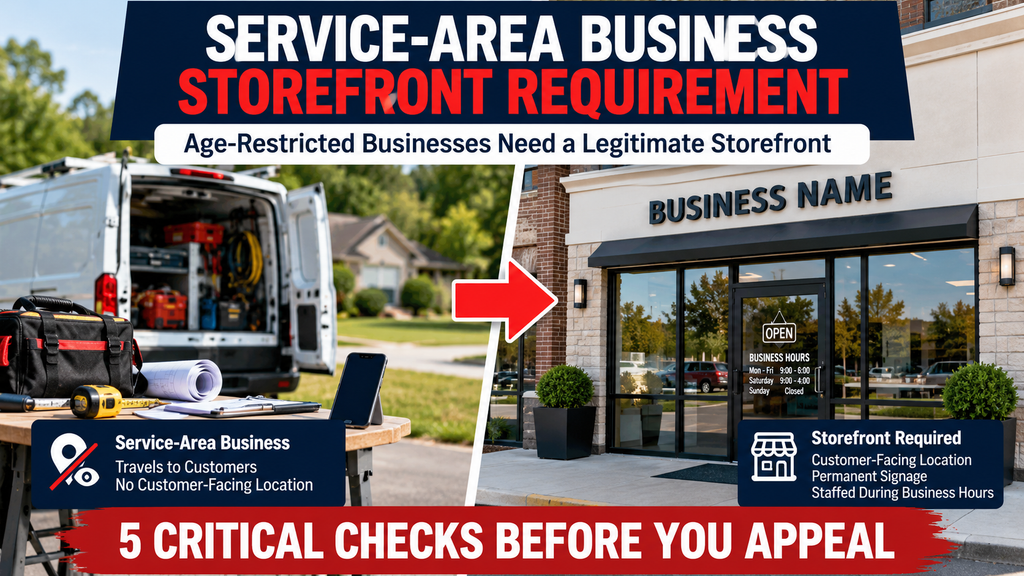
Google’s current Business Profile guidance includes an important eligibility restriction for certain service-area businesses.
Businesses associated with products or services that require customers to meet a minimum age requirement — Google gives examples including alcohol, cannabis, and weapons — are not permitted as service-area businesses without a storefront.
That matters because this is not always a verification problem.
It can be an eligibility problem.
For a typical plumber, roofer, cleaner, or HVAC company, operating as a service-area business without a customer-facing storefront may be completely normal.
For an age-restricted business, the rules are different.
Before preparing a suspension appeal, the first question should be:
Does this business actually qualify under Google’s current service-area rules?
Google’s official Google Business Profile guidelines state that businesses associated with age-restricted products or services are not permitted as service-area businesses without a storefront.
What Is the Service-Area Business Storefront Requirement?
Google’s current guidance says businesses associated with products or services that require customers to meet a minimum age are not permitted as service-area businesses without a storefront.
Google gives examples including:
- Alcohol
- Cannabis
- Weapons
Because Google uses examples such as these, businesses involving other age-restricted products or services should also be reviewed carefully rather than assuming the rule applies only to those three categories.
The key issue is simple:
If the business falls into an age-restricted category, does it have a legitimate customer-facing storefront?
Why This Matters for GBP Suspensions
A business owner may believe the problem is:
- Failed video verification
- A utility bill
- An address mismatch
- Hidden-address settings
- Business licensing
- Service-area configuration
- Insufficient appeal evidence
But if the business is age-restricted and does not have a legitimate storefront, collecting more documents may not solve the underlying issue.
The problem may be eligibility itself.
That changes how the case should be evaluated before a reinstatement appeal is prepared.
If you are not sure whether the profile is suspended, unverified, or simply not appearing in search, start with our Google Business Profile Not Showing? 7 Critical Checks guide.
1. Determine Whether the Business Is Age-Restricted
Start with this question:
Does the business sell or provide products or services that require customers to meet a minimum age requirement?
If no, this specific storefront restriction may not apply.
If yes, immediately determine whether the business has a legitimate storefront.
Do not automatically treat the case like a standard home-based service-area business.
2. Confirm That the Storefront Is Real
Having an address is not the same as having a storefront.
A legitimate storefront should reflect how the business actually operates.
Look for facts such as:
- Customers are actually served there
- The location is staffed during business hours
- Permanent business signage is present
- The business genuinely operates from the location
- The profile accurately represents the real-world business
Simply adding an address to the Business Profile does not automatically turn a service-area business into a storefront.
3. Check Permanent Signage and Customer Access
Permanent signage and customer access matter.
Before treating the location as a storefront, verify:
- Is there permanent signage with the business name?
- Can customers actually visit the location?
- Is the business staffed during stated hours?
- Are customers served there?
- Does the location appear to operate as a real business location rather than simply a mailing address?
If those facts cannot be established, displaying an address may not solve the underlying eligibility issue.
4. Review Coworking Spaces and Virtual Offices Carefully
A coworking location is not automatically prohibited.
But it also is not automatically a valid storefront.
The right questions are:
- Does the business genuinely operate there?
- Is the location staffed by the business?
- Can customers visit?
- Is permanent signage present?
- Are customers actually served there?
- Does the business have a real presence at the location?
A mailbox, rented address, or virtual office alone does not establish storefront eligibility.
5. Gather Evidence That Proves the Storefront
If the business does have a legitimate storefront, the evidence should prove the location itself.
Useful evidence may include:
- Exterior storefront photos
- Permanent signage
- Interior business photos
- Customer-facing areas
- Staffed business hours
- Business licenses
- Industry-specific licenses
- Lease or occupancy documents
- Utility bills
- Business registration
The goal is not simply to prove that the business exists.
The evidence should also prove that the business operates from a legitimate customer-facing storefront.
That is an important distinction.
What If the Business Works From Home?
Many legitimate service-area businesses operate from residential addresses.
That can be completely normal for businesses such as:
- Plumbers
- Cleaning companies
- Roofers
- HVAC companies
- Landscapers
- Mobile service providers
But the age-restricted storefront requirement creates a different eligibility issue.
If the business provides age-restricted products or services and does not have a legitimate storefront, standard service-area eligibility may not apply.
That is why these cases should not be handled like a typical home-based contractor.
What If the Business Is Already Suspended?
Do not automatically prepare the appeal.
First determine whether the business is eligible under the storefront requirement.
If the business has a legitimate storefront
Check:
- Permanent signage
- Customer access
- Staffed business hours
- Address accuracy
- Business licensing
- Business documentation
- Whether customers are genuinely served there
- Whether the profile accurately represents the location
Then build the appeal around the actual evidence.
If the business does not have a storefront
Do not assume that stronger:
- Utility bills
- Business registrations
- Licenses
- Verification videos
- Tax documents
will solve the issue.
Those documents may prove the company exists.
They do not necessarily prove that the business qualifies under Google’s age-restricted service-area rules.
If the first appeal has already been denied, review our Google Business Profile Additional Review After a Denied Appeal guide before submitting anything again.
Should You Change the Profile From Service-Area to Storefront?
Only if the business actually qualifies.
Do not add an address simply to try to satisfy Google.
A real storefront should genuinely be:
- Customer-facing
- Staffed
- Open during stated business hours
- Supported by permanent signage
Changing the profile to look like a storefront when the business does not actually operate that way can create another compliance problem.
What If Google Is Asking for Verification?
Verification and eligibility are not the same thing.
A business can have a verification problem and still be eligible.
It can also fail verification because the underlying business setup does not match what Google expects.
If the business appears eligible but Google is no longer offering a usable verification method, read No More Ways to Verify Google Business Profile before changing the listing or creating another profile.
The first step is always to determine the exact status of the profile.
Does the Address Have to Be Public?
Not necessarily in every case.
The important question is whether the business has a legitimate storefront when Google requires one.
For ordinary service-area businesses, hiding the address may be appropriate if customers are not served there.
For an age-restricted business, the bigger issue is whether a qualifying storefront exists at all.
The profile should reflect how the business actually serves customers.
What This Changes in a GBP Suspension Evaluation
For age-restricted businesses, add this question near the top of intake:
Does the business sell or provide a product or service that requires customers to meet a minimum age requirement?
If yes, verify:
- Does the business have a legitimate storefront?
- Do customers actually visit the location?
- Is the location staffed during posted hours?
- Is permanent signage present?
- Does the business genuinely operate there?
- Does licensing support that location?
- Does the Business Profile accurately represent the setup?
If the business cannot establish a legitimate storefront, do not automatically treat the case as a normal service-area suspension.
Frequently Asked Questions
Can an alcohol business operate as a service-area business on Google?
Google says businesses associated with age-restricted products or services, including alcohol, are not permitted as service-area businesses without a storefront.
Can a cannabis business use a Google Business Profile without a storefront?
Google specifically lists cannabis as an example of an age-restricted business affected by the storefront requirement.
Can a weapons-related business operate as a service-area business?
Google specifically lists weapons as another example of an age-restricted category affected by the rule.
Can I just add my home address?
No.
Adding an address does not automatically establish storefront eligibility.
The location still needs to operate as a genuine customer-facing business location.
Does a coworking office count as a storefront?
Not automatically.
The business still needs to genuinely operate there, serve customers there, have appropriate staffing, and meet Google’s location requirements.
Do normal service-area businesses have to display an address?
No.
A typical service-area business that does not serve customers at its business address may operate with the address hidden.
The age-restricted storefront requirement is an important exception.
When did Google introduce this restriction?
The restriction is present in Google’s current official guidance and was verified by GBP Suspensions on September 26, 2026.
Google does not provide a publication or effective date for the restriction, so September 26 should be treated as the date the rule was verified, not necessarily the date it was introduced.
The Bottom Line
The service-area business storefront requirement creates an important eligibility check for age-restricted businesses.
If a business sells or provides products or services that require customers to meet a minimum age requirement, determine whether it has a legitimate customer-facing storefront before treating the case as a standard suspension or verification issue.
If a storefront exists, document it carefully.
If it does not, the problem may be eligibility rather than missing evidence.
That can completely change the reinstatement strategy.
If your Google Business Profile is suspended and you are unsure whether the business model or location meets Google’s current requirements, GBP Suspensions can review the profile, business model, location, and available evidence before an appeal is submitted.